The Hill

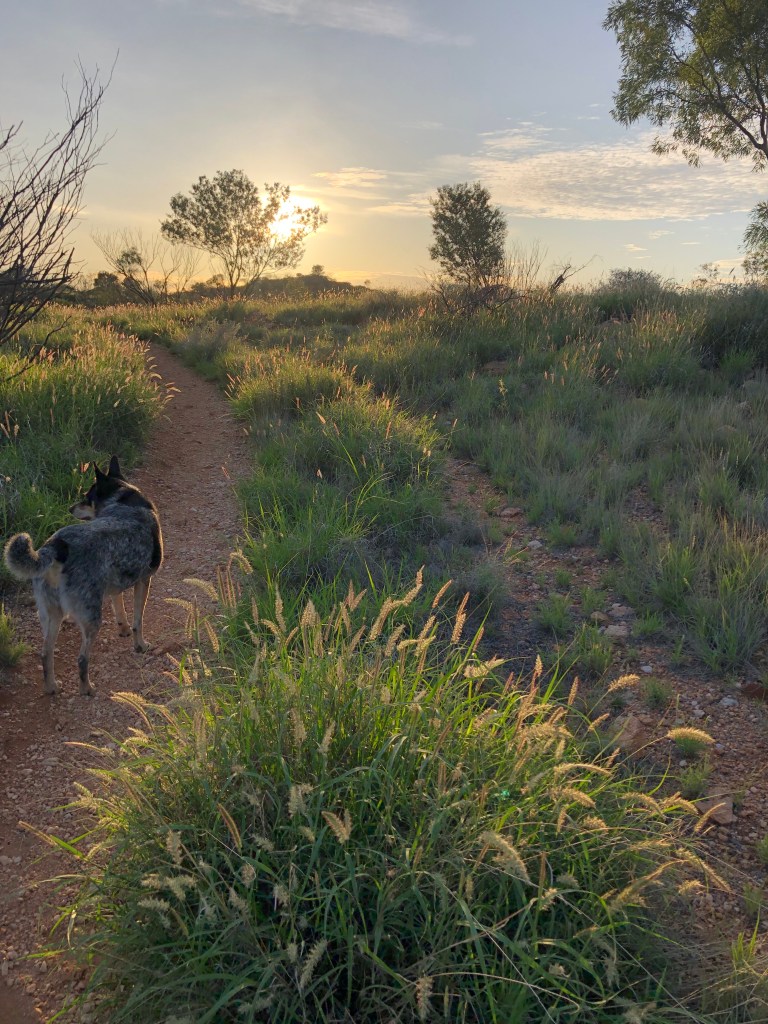
I’m in Alice Springs again, time out to write and look for family in the tangled recesses of the internet. House sitting and dog minding for friends of friends. It’s summer hot, and every morning we walk the hill. We – me and Jip – an aging blue heeler kelpie cross with a wicked sense of humour.

The hill is one of many stony outcrops on this eastern edge of town. Just one hill of many, crossed by multiple narrow tracks, many part of a ‘mountain’ bike network, graded and labelled with names and directional arrows. We walk the Eastside track and then branch onto the Inarlenge track, then scramble down through Henry’s ‘patch’ – one of several patches where a local is working to eradicate the invasive buffel grass – then along a sandy creek bed, passed Valmai’s ‘patch’ and then home.

It’s a crunchy, slippery walk. The rocks here dissolve into a quartz gravel that rolls under your boots. Jip skips down those bits, four legs make for greater stability than my two, while I creep, one foot, the next, stopping my slides on grassy clumps of buffel, the weed that dominates this landscape and, when alight, burns hot and dangerous.

The path is narrow, with dense buffel on either side, until we get to Henry’s patch. Not really a patch, more a small valley, enfolded between two high points. Henry has been weeding out the buffel for years here, digging it out, laying it flat, and then watching the landscape recover. No need to plant, the seeds of grasses, wattles, and more are there waiting. Here the path is edged with the tall stems of kangaroo grass, starting to form their distinctive ochre-coloured seed heads. It’s a joy to see them.

In the days before I arrived, warm wet air from the northern monsoon streamed across central Australia, dumping rain in Alice and across the Simpson desert, right through to northern Victoria. Rain, rain and more rain. Nourishing floods filling up the landscape with moisture, but hard for those who can’t move their homes out of the way. Our land tenure system fails when it floods, or burns. We are stuck in the way, evacuated out, but inevitably returning to that patch of ground called home, until the next time.

Arriving in Alice, there was water in the Todd River. A first for me after years of mainly winter visits. They say that January-February is when the Todd might flow, hooking into the monsoon, with water coming down at the hottest time of year.

Back to the buffel. Out in the Simpson earlier this year I learnt that it had been introduced for the pastoralists, one of the many ideas about how to improve the Australian landscape for farming. Buffel is a clumping grass, dense and domineering. It crowds out the native millet, toothbrush grass, feather grass and even the tall kangaroo grass. Where there is buffel there is little else.

Valmai is out tending her patch as we turn for home. She’s been out since first light. Her approach now is to spray the buffel, in part because weeding the big clumps out is getting too hard, and through observation she’s realized that the dead buffel holds the soil together, and then the ‘termites come to feast and after a couple of seasons only a skeleton remains. Her patch is measured in acres. It’s beautiful. A sandy creek beds weaves through, with tall grasses marking its course.  Her patch runs up and over a hill. Valmai points out the different grasses: several look to me like buffel – an oat grass I think she said. But her eyes are sharply attuned, and mid sentence she dives to pull out some young buffel plants, hanging them roots-up on a woody shrub – the Bradley method – or tossing them back onto the thick wall of buffel that marks the current edge of her patch.

Climb up onto the hill she suggests. Is there a path, I ask. You’ll find your way up, she says. The view is magnificent and you will see a lot from there.
Feet on Country

He said: ‘No feet on Country for decades now’. I hear him, an Elder of one of the Traditional Owner groups connected to Gariwerd, the soaring ranges European explorer Thomas Mitchell called the Grampians after a range in his native Scotland. What it means to have no feet on Country reverberates inside me, a hum of meanings and entanglements.

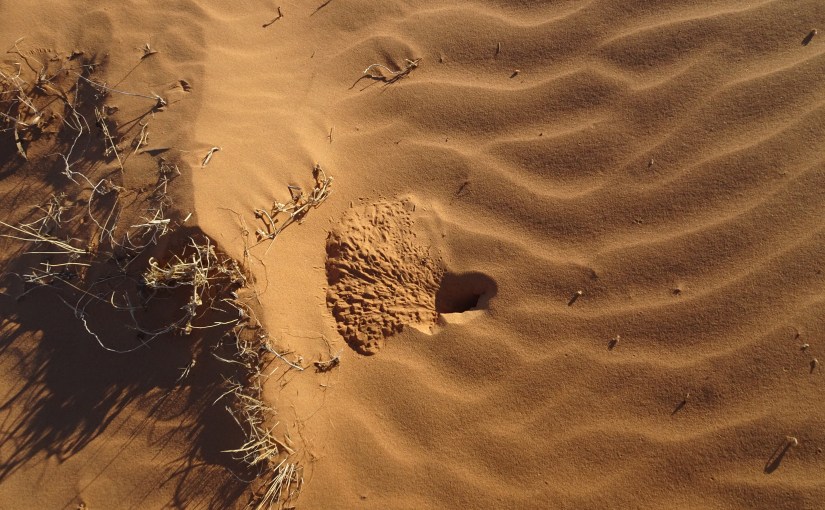
A desert of sand and dunes rolls out in front of me. The room disappears. We are walking Country: to see it, feel it, nurture it with our presence. We are in the footsteps of Wangkangurru people as they walked their desert, travelling between mikiri – water wells dug deep into the sand.

The desert fades. The room is full of voices, talking about what it means to look after Country. One man says: ‘the bush is a mess … too thick … the trees can’t breathe’, another that looking after Country means being ‘hands on’, caring for it with your own sweat work. It means being there, listen, hearing Country speak.

Mitchell’s wagon tracks cut deep into Country, the first of many shocks. Not feet, nor the caress of hands, of language and song.

That room, those voices seem like a lifetime ago: BC, before COVID, but it’s just a few months. My last desert walking was 2019, September, not quite a year. Afterwards I wrote about that trip into the eastern Simpson Desert, about meeting with Dr Karl Vernes, and about his search for what was once favoured Wangkangurru tucker – the Desert Rat Kangaroo. Now extinct or is it?

Here is a link to what I wrote: Gone to ground, or gone for good?

One more time with feeling

It was the last day and still they climbed. Nose to tail. Conquering. Ticking off the bucket list. Disrespecting.

The climb has closed, the desecration of Uluru ended.

Closing the climb has been debated for years, desired by the traditional owners but contested by tourism operators. Two years ago, after the proportion of visitors climbing fell below the trigger level for closure, the fate of the Climb was sealed.

At the end, they came in their thousands. Not to celebrate its closure, but to climb.

Back in 2001 Hilary du Cros and I gave a paper on two sacred places – Pashuputinah and Uluru – at the Australia ICOMOS Making Tracks conference in Alice Springs. In the paper we reflected that travelling to ‘Ayers Rock’ was like a secular pilgrimage, a process of paying respect in photographs or through the Climb, but visiting Uluru was to experience another place entirely. As our paper revealed, back then many tourism operators still called it ‘Ayers Rock’ and few promoted the ‘don’t climb’ message.

Responding to a place – and how culture shapes what and how we see place – motivates my work. Uluru has entranced me since my first visit in 2001, and Uluru has called me back many times.

Climbing Uluru, once a sacred journey became one framed by challenge – conquering a ‘mountain’. Climbing was how to engage with this place. What might it feel like to climb?

In 2018, after visiting again, I wrote about Uluru and the Climb: first as non-fiction (‘The Climb’) and then a fiction fantasy (‘The last climb at Ayers Rock’). I’m sharing them here, as part of my first blog post to celebrate the closure of the Climb.

Shifting into fiction moved the focus from my own experience. The climbers are lightly sketched, in a way suggesting that they are insubstantial compared to Uluru itself, and yet one of them has history here. And I wanted my sense of the spirit of Uluru to somehow overwhelm the characters – Bill and his family – and perhaps transform them. On a deeper personal level, why did I want Bill and his family to climb? And to become lost, engulfed and maybe transformed? There is something about the transformative nature of imagining being able to see the world through another’s eyes and culture. It is not an authentic ‘seeing’ as we can never be other than who we are. But sometimes a window opens, and for a moment our world is different: there are creation ancestors shaping the land, trees can fly, giant snakes can rebirth Uluru.