
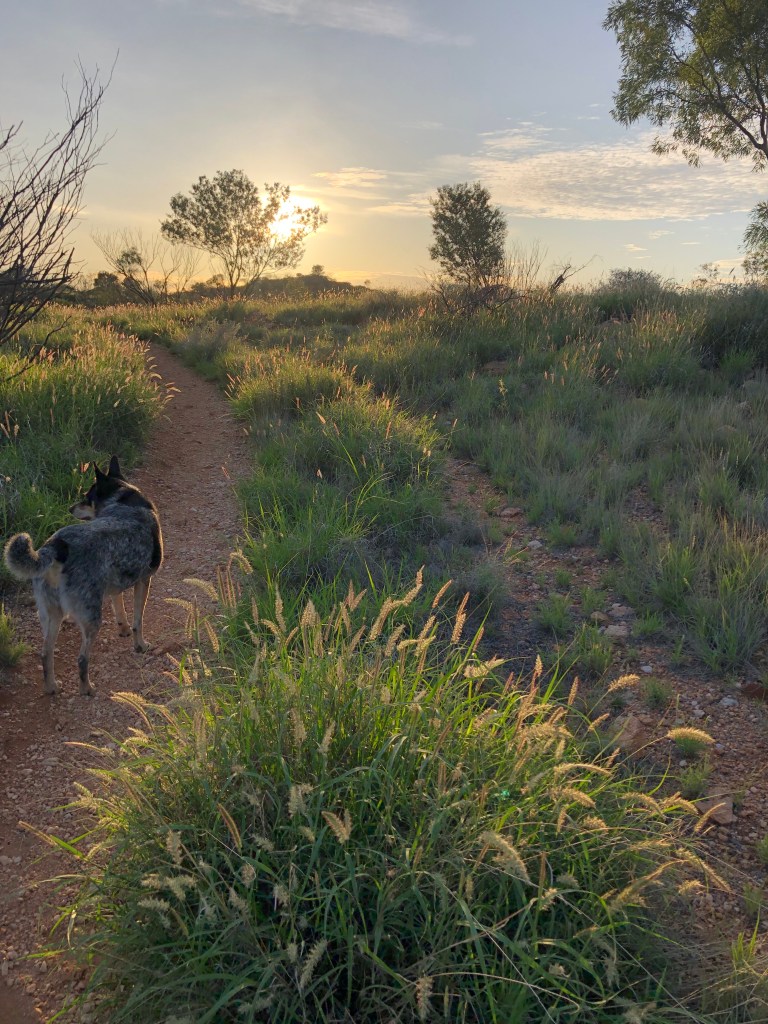
I’m in Alice Springs again, time out to write and look for family in the tangled recesses of the internet. House sitting and dog minding for friends of friends. It’s summer hot, and every morning we walk the hill. We – me and Jip – an aging blue heeler kelpie cross with a wicked sense of humour.
The hill is one of many stony outcrops on this eastern edge of town. Just one hill of many, crossed by multiple narrow tracks, many part of a ‘mountain’ bike network, graded and labelled with names and directional arrows. We walk the Eastside track and then branch onto the Inarlenge track, then scramble down through Henry’s ‘patch’ – one of several patches where a local is working to eradicate the invasive buffel grass – then along a sandy creek bed, passed Valmai’s ‘patch’ and then home.
It’s a crunchy, slippery walk. The rocks here dissolve into a quartz gravel that rolls under your boots. Jip skips down those bits, four legs make for greater stability than my two, while I creep, one foot, the next, stopping my slides on grassy clumps of buffel, the weed that dominates this landscape and, when alight, burns hot and dangerous.
The path is narrow, with dense buffel on either side, until we get to Henry’s patch. Not really a patch, more a small valley, enfolded between two high points. Henry has been weeding out the buffel for years here, digging it out, laying it flat, and then watching the landscape recover. No need to plant, the seeds of grasses, wattles, and more are there waiting. Here the path is edged with the tall stems of kangaroo grass, starting to form their distinctive ochre-coloured seed heads. It’s a joy to see them.
In the days before I arrived, warm wet air from the northern monsoon streamed across central Australia, dumping rain in Alice and across the Simpson desert, right through to northern Victoria. Rain, rain and more rain. Nourishing floods filling up the landscape with moisture, but hard for those who can’t move their homes out of the way. Our land tenure system fails when it floods, or burns. We are stuck in the way, evacuated out, but inevitably returning to that patch of ground called home, until the next time.
Arriving in Alice, there was water in the Todd River. A first for me after years of mainly winter visits. They say that January-February is when the Todd might flow, hooking into the monsoon, with water coming down at the hottest time of year.
Back to the buffel. Out in the Simpson earlier this year I learnt that it had been introduced for the pastoralists, one of the many ideas about how to improve the Australian landscape for farming. Buffel is a clumping grass, dense and domineering. It crowds out the native millet, toothbrush grass, feather grass and even the tall kangaroo grass. Where there is buffel there is little else.
Valmai is out tending her patch as we turn for home. She’s been out since first light. Her approach now is to spray the buffel, in part because weeding the big clumps out is getting too hard, and through observation she’s realized that the dead buffel holds the soil together, and then the ‘termites come to feast and after a couple of seasons only a skeleton remains. Her patch is measured in acres. It’s beautiful. A sandy creek beds weaves through, with tall grasses marking its course. Her patch runs up and over a hill. Valmai points out the different grasses: several look to me like buffel – an oat grass I think she said. But her eyes are sharply attuned, and mid sentence she dives to pull out some young buffel plants, hanging them roots-up on a woody shrub – the Bradley method – or tossing them back onto the thick wall of buffel that marks the current edge of her patch.
Climb up onto the hill she suggests. Is there a path, I ask. You’ll find your way up, she says. The view is magnificent and you will see a lot from there.




 grounded practice