Square in name only, a place to celebrate, protest, say ‘sorry’, eat and perhaps have one too many. Melburnians now have their longed for civic square. But change is coming and the debate is heating up.
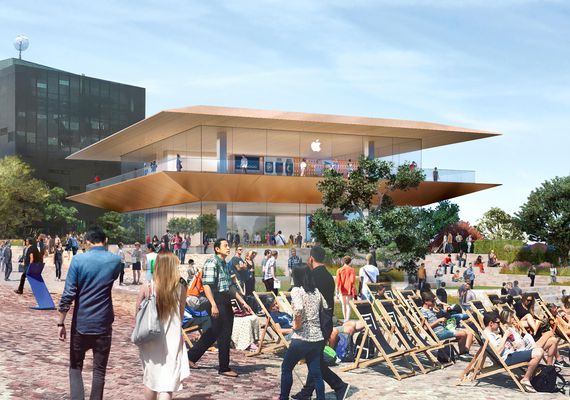
Challenging architecture aside, Federation Square is Melbourne’s much loved public ‘square’. Tania Davidge, architect and writer, is leading the OurCityOurSquare campaign to prevent Apple landing an alien architectural form into this precious place. She shares her public space mantra with me and wishes the government would listen.
“Public space is a negotiation between people, government, and private interests. And if that gets out of balance or if we don’t participate in that conversation we’ll get the public space that’s given to us,” says Davidge.
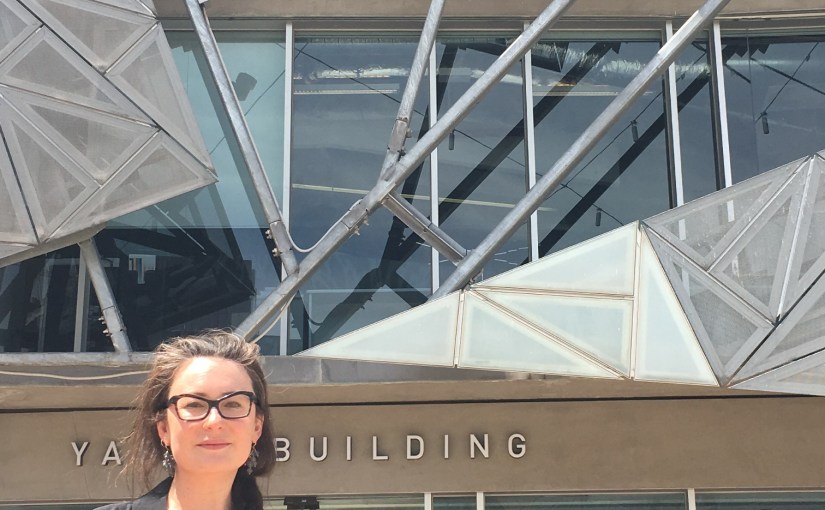
Her voice echoes in this intimate space, tucked into the south side of the Yarra Building, the piece of the Fed Square ensemble that will make way for Apple. Helicopters hover overhead repeatedly, and the hot north wind somehow sneaks in, blowing wisps of her well-plaited hair across her face.
Controversy is part of the DNA of Fed Square. The vision was right – then Victorian Premier Jeff Kennett declared that Federation Square would see “the creation of a new centre of cultural activity for Melbourne – the long-awaited open public civic destination.”

The winning design was denounced as ugly. Architects, Donald Bates and Peter Davidson (Lab Architectural Studio) jumped to its defence. Public opinion battled architectural aesthetics, and the Western Shard was sacrificed.
But when Fed Square opened in 2002, Melburnians fell in love with the quirky design, Kimberley stone paving, cafes and bars. In the first six months there were more than 3 million visitors; today it’s over 10 million annually, more than the Sydney Opera House.
Then, just before last Christmas, the deal with Apple was announced. Community outrage was palpable; three petitions hit social media within days.
Leading the OurCityOurSquare campaign is the newly formed Citizens for Melbourne Inc. Using Instagram and well-targeted emails, architect and historian Rohan Storey linked key people into what has become a tightly knit and highly effective team, with Tania Davidge at the helm. Storey says: “She took the running, knew what to do, was very enthusiastic and has the time and energy.”

Davidge, an architect, is direct and forthright. She didn’t plan to be in this leadership role, and yet here she is, and enjoying it: “all of a sudden I was the president … I said yes, not really realising what would happen… [and] it’s been a really interesting journey… I’ve grown into it.” Campaigning skills seem to emerge naturally from her Melbourne-based architectural practice OpenHAUS where she creates projects as “catalysts” to get people talking about the built environment.
Davidge describes the campaign as “an ecology of activism,” a living organism, reaching its tentacles in all directions and drawing in people and ideas. “Our constitution talks about us being advocates for public space – the quality of public space – in greater Melbourne,” she says. OurCityOurSquare is just the first campaign perhaps of many.
Architects, urban planners and designers are their natural constituency, and many have joined. As Felicity Watson, Advocacy Manager at Victoria’s National Trust points out there is power in talking to your own: “rather than a heritage person… saying to architects ‘well this is what you should care about’” architects have been talking to architects about protecting good architecture.

Like the wind, right now the campaign is running hot. The National Trust’s nomination of Fed Square to the Victorian Heritage Register was a strategic curved ball. It’s opened the door for public submissions, a door the government had firmly closed. Davidge says there are at least 500 submissions so far, two weeks out from the deadline. “[That] Richard Wynne, as Planning Minister invoked his authority to remove public consultation … to not have public debate on this is an appalling oversight,” says Davidge.
Watson says that their nomination caused “a lot of ripples… because they hadn’t expected it [maybe now] they’ll proceed with a little bit more caution… around what may be significant.” On the other hand, Storey suggests it could offer the state government a way out: “if they’re not totally committed [to the project they can say] ‘Well, whatever Heritage Victoria says goes’” and walk away.
Bates, now chair of architectural design at Melbourne University, staunchly defended the Lab design for Federation Square during the brutal design debates in the late 1990s. He now supports the Apple Store. “I knew that my decision to… allow an Apple Concept Store to replace the Yarra Building would be controversial. That I would be pilloried and abused.”
More surprising is that Bates appears to have become an apologist for the government’s position, arguing for the destruction of part of his own design. Meanwhile, the government itself has gone quiet.
While his position causes puzzlement, the quality and coherence of his architecture is not in question; it is after all the focus of the National Trust’s heritage nomination. Davidge doesn’t see her role as a battle with Bates: “I don’t think it’s about going head-to-head with him… he’s got an opinion, I don’t necessarily agree with it.”
In her mind, the Government’s decision reflects a “lack of thinking” and a failure to look for the best solution. And they don’t appear to be listening. “You write letters and you just get pro-forma responses… a bit disillusioning.” She says that as activists they didn’t have a “ready-made platform to speak from. You have to build that voice” and then fight to get into the conversation. “Politicians can’t be seen to be backing down… I think we’re lacking a bit of humanity in politics.”
With more than 100,000 signatures to online petitions, 800 submissions to the City of Melbourne, and 500 submissions on the heritage nomination, and still counting, their voice is getting louder.
What would success look like? For Davidge it’s no Apple Store in Fed Square. Watson and Storey concur. But it’s also about winning hearts and minds. Watson says that the campaign is already a success – it has “a really good story and a really clear narrative that people can connect to.” But is this enough?
Federation Square aside, for Davidge the bigger story is the loss of our public commons. “We need to value and safeguard and expand our public spaces … these spaces [are] where we can express our citizenship… and celebrate our community. The corporatisation of our public places has been creeping slowly… we’ve become acclimatized to it.”
[Tania Davidge speaks out at the OurCityOur Square campaign rally]
Her next challenge is to demonstrate a credible alternative. Watson says “if you don’t want something to happen, you might have to solve that problem a different way, so what are the possible solutions?” For Davidge that starts with the newly announced principles for a People’s Plan.
Would she do this again? Throw herself headlong into a public campaign? Davidge laughs: “I think I’d need a bit of a nap first.” She walks to the front of the Yarra Building. Strong against the gusting wind, a defender to the last. “We’re actually part of that history of the fight for Melbourne’s public space,” she says.
 grounded practice