(to view the published format as part of Co-Lab 2021, click here)
The calls are deafening. The birds have come, straight out of Hitchcock’s nightmare. One day just a few, then tens, then hundreds. Harsh-voiced calls, constant, surround-sound. Nothing can blot them out.
I open the door to a rush of wings. The occupying army takes flight, protesting the intrusion of human. It is their place now. I retreat and they resume their march back towards the house. So black. Piercing beak, sharp eye. I look out through the window – they stare back, chiding me for my indolence. The landscape is a moving carpet of ravens.
For months the cup moth caterpillars have munched through eucalypt leaves. A rain of green balls litters the ground: leaves into fertilizer. The trees are stripped, almost bare. And then the caterpillars fall. A rain of fat, stinging fat caterpillars, seeking the ground, a place to pupate.
Every underneath is filled with round pupating balls. Don’t stand still.
And then the ravens come. One and then a hundred. I hear them coming closer, working through the forest. And then they are here, surrounding the house. Every crevice probed, squabbled over, pupae cracked, eaten.
Excited, I post on facebook about this new phenomenon. I am told it is ancient. I am what is new.
Black as night
all colours in my darkness
white-eyed, far-seeing.
I fly.
My wings lift
on the earth’s breath.
Calling the
sky, the wind
my mate.
Echoing long
so all can hear
my warning.
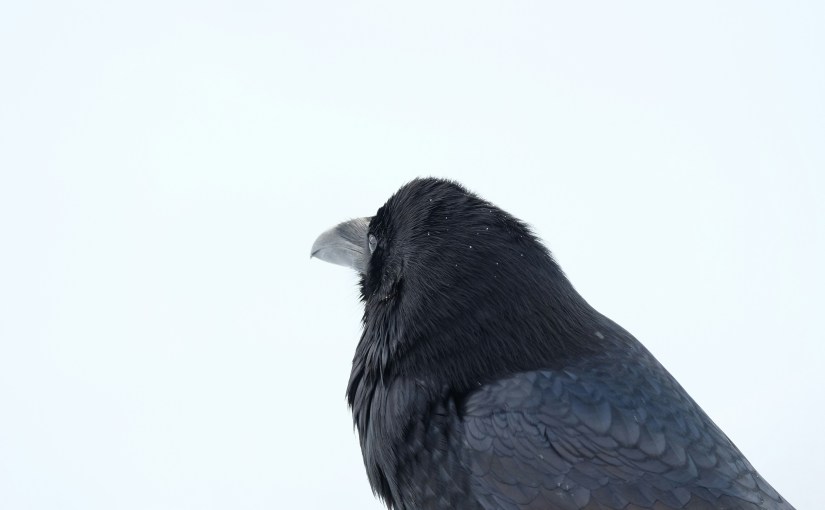
Ravens are an ancient species. The blackest of birds, wholly black from feet to tongue, their feathers gleam green and purple.
Sociable, nomadic and flocking, huge gatherings of Little Ravens are known to congregate to exploit a sudden flush of food. Gleaners and reapers, not lamb killers, Little Ravens eat insects, spilt harvest grain, and carrion, walking with a swagger or hopping nimbly. Their baritone call is a guttural ark-ark-ark. Ravens mate for life.
A raven, once white and beloved of Apollo, was sent to spy on Apollo’s unfaithful lover. Returning, with this news, the raven was scorched black through Apollo’s fury.
Beware bad-tempered bosses.
Waa, the white raven, tricked the Karatgurk women – the seven sisters who held all the fire in the world on the top of their digging sticks. As the women beat off the snakes Waa had hidden, he grabbed the broken sticks but flew so fast, he was burnt into blackness.
Beware hoarding. Fly with care.
Back at the beginning of time, the snow-white raven discovered the Grey Eagle was keeping the sun, moon, fresh water and fire from people. Having hung the sun and moon in the sky, dropped the fresh water on the land, the raven flew on, holding the brand of fire in his bill. The smoke from the fire blew back over his white feathers and made them black. When his bill began to burn, he dropped the firebrand. It struck rocks and hid itself within them.
Beware: good deeds can change you forever.
Enli, impatient with the noise of humans, seeks to destroy the world with a flood.
Yaweh, furious at the corruption of man, seeks to flood the earth.
The sea, angry at the Kulin people, at their fighting, waste and neglect of Country, rises until it covers the plains.
Warned, Utnapishtim is instructed to build a boat so that life might survive.
Noah warned by Yaweh, is instructed to build an ark to preserve human and animal life.
Utnapishtim, loads all the living beings, his family, craftsmen, and seals the door. So fierce the storm, even the gods were afraid.
Noah sends his wife, children and friends on board, with both clean and unclean animals.
After six days and nights of storm and flood, Utnapishtim looks out on the flattened land. All the humans had returned to clay.
After 40 days and nights, the waters receding, the world is washed clean.
He sends a dove, but it returns. He sends a swallow, and it returns. He sends a raven. It did not circle back – finder of food.
An emissary is sent. A raven, black as coal, circles above until the waters are dried up from the earth.
A raven, feasting on the drowned. Symbol of evil or harbinger of survival?
God-like, hovering over the waters. The rebirthing the world.
Bunjil was entreated to stop the rising sea. But first Bunjil demanded the people change their ways. Then he raised his spear and commanded the sea to stop rising. Nerm remains flooded.
As the seas rise again, who are our emissaries?
Sources:
Briggs, Carolyn, Bunjil: the time of chaos, https://cv.vic.gov.au/stories/aboriginal-culture/meerreeng-an-here-is-my-country/bunjil/; Clark, Ella E. 1953, Indian Legends of the Pacific Northwest, University of California Press; Epic of Gilamesh; Mudrooroo (1994). Aboriginal mythology: An A-Z spanning the history of the Australian Aboriginal people from the earliest legends to the present day. London: Thorsons. pp. 35–36.; The Kanatgurk and the Crow, from Australian Dreaming: 40,000 Years of Aboriginal History (1980) Comp. Jennifer Isaacs, Lansdowne Press, Sydney, NSW, pp. 107–108; The Raven and the Dove, Parshas Noach (https://torah.org/parsha/noach/); Walsh, Larry, Black Crow, https://cv.vic.gov.au/stories/aboriginal-culture/meerreeng-an-here-is-my-country/black-crow/
 grounded practice